
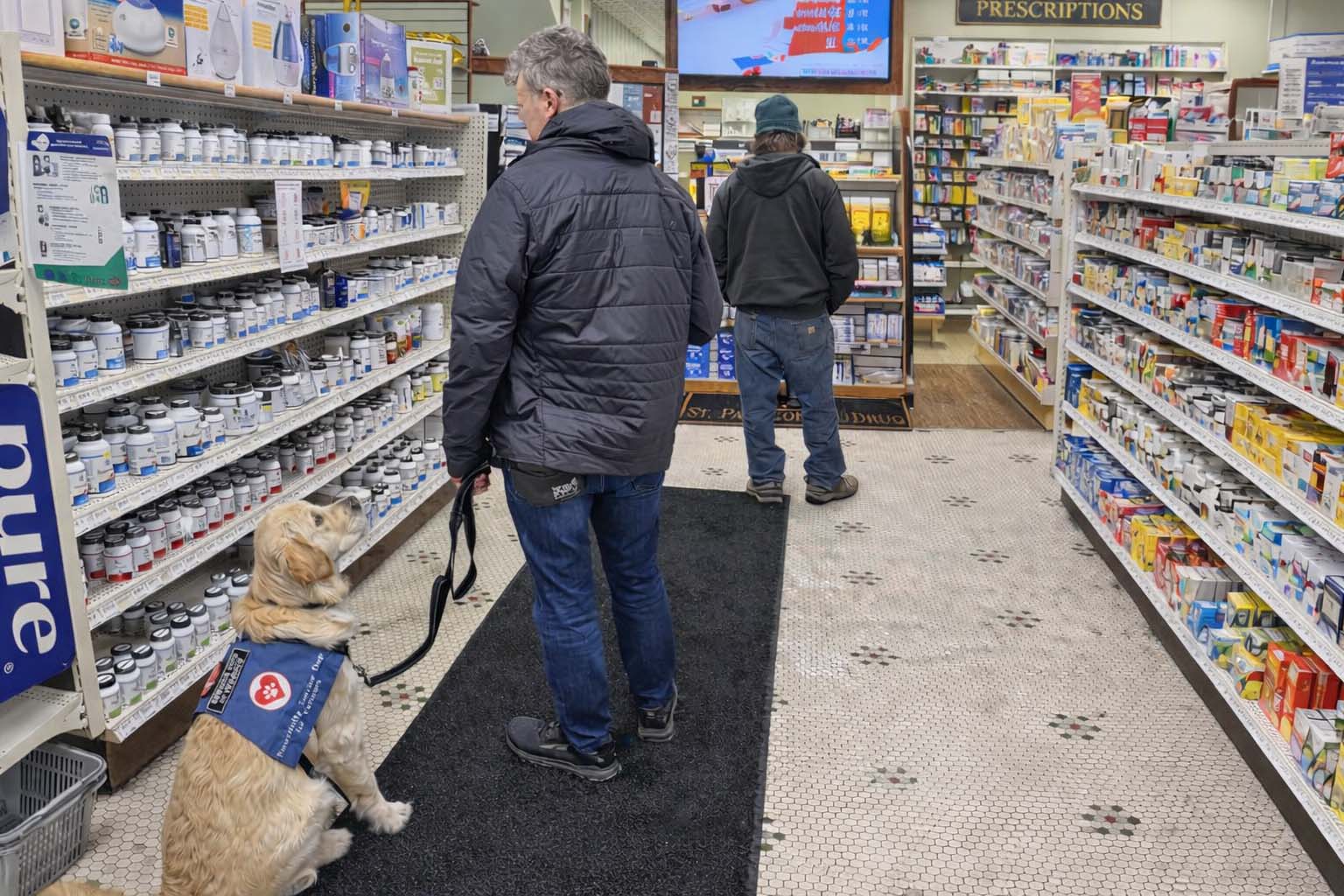
Service dogs provide forms of support that other interventions cannot.
Detection
Service dogs can offer help in ways that other types of support cannot.
Unlike care that happens on a schedule or only after symptoms get worse, a trained service dog can notice early signs of stress. These signs may include changes in breathing, repeated movements, or rising muscle tension. Many veterans do not notice these signs themselves.
Research shows that dogs can also respond to small body changes linked to stress and anxiety. A study from the University of Arizona noted that these early signals can help a trained service dog step in before symptoms escalate. [1] The dog may do this by nudging, applying calming pressure, or guiding movement. These actions can interrupt the stress response and help the veteran re-focus on the present moment.
Support Without Medication Side Effects
Many veterans benefit from medication, but medications can also cause side effects. These side effects may require ongoing management and sometimes lead to taking additional medications.
A service dog does not replace medical care. Instead, it adds another layer of support. A service dog can help some veterans reduce distress and function better day to day, without medication-related side effects.
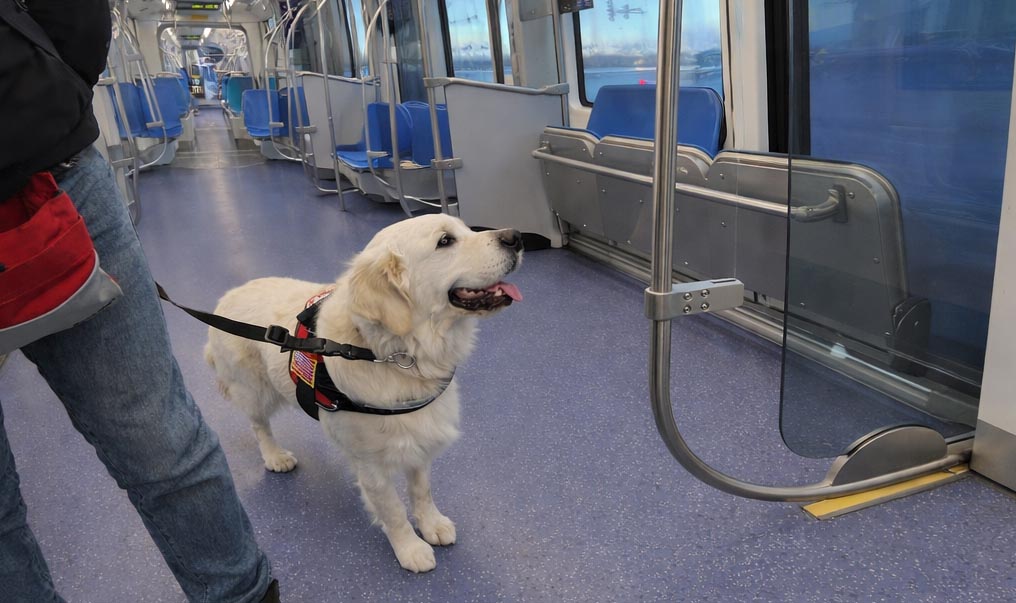
A service dog maintaining positioning while traveling on public transit.
Real-Time Support, Throughout Daily Life
Researchers often say that steady routines and support from others are key to recovery. Some call this the “scaffolding” that helps people rebuild stability. [2] Therapy and medication can also help, but they happen at set times, may be limited in how long they last, or depend on the veteran noticing symptoms early enough to use a coping strategy.
A trained service dog is different because the support happens in real time, in everyday settings:
- Continuous presence and routine. The dog is there throughout the day, not just during appointments. That steady presence can help veterans maintain daily structure and follow through on routines, even when symptoms flare.
- In-the-moment task support during symptoms. Depending on the veteran’s needs and the dog’s training, a service dog may interrupt escalating anxiety or dissociation, wake a veteran from nightmares, prompt grounding behaviors, or provide steadying support during sudden startle or spikes of anxiety.
- Safety feedback in public spaces. Many veterans describe feeling on high alert in everyday places. Through trained positioning, practiced public-access routines, and calm behavior, a service dog can help reduce hyper-vigilance and support the veteran’s engagement in public settings instead of withdrawal.
One Dog Can Support Multiple Disabilities at Once
Many veterans live with more than one disability, and symptoms often interact in ways that make daily life harder. A veteran may experience PTSD alongside traumatic brain injury, chronic pain, tinnitus, migraines, or depression. Pain can disrupt sleep, poor sleep can increase stress, and sensory overload can trigger anxiety. When challenges stack, everyday tasks can become difficult.
Veterans may be managing conditions such as:
- traumatic brain injury (TBI)
- tinnitus or hearing loss
- chronic pain or mobility limitations
- migraines
- depression, concentration challenges, or memory difficulties
A trained service dog can provide task-based support across these overlapping needs. Depending on the veteran’s goals and the dog’s training, that can include mobility and balance support, retrieving dropped items, sound alerts, deep-pressure support for anxiety, guiding to an exit or a safe space, and cues that help with grounding and emotional regulation.
Few interventions can address so many day-to-day barriers at the same time, especially in the real-world settings.
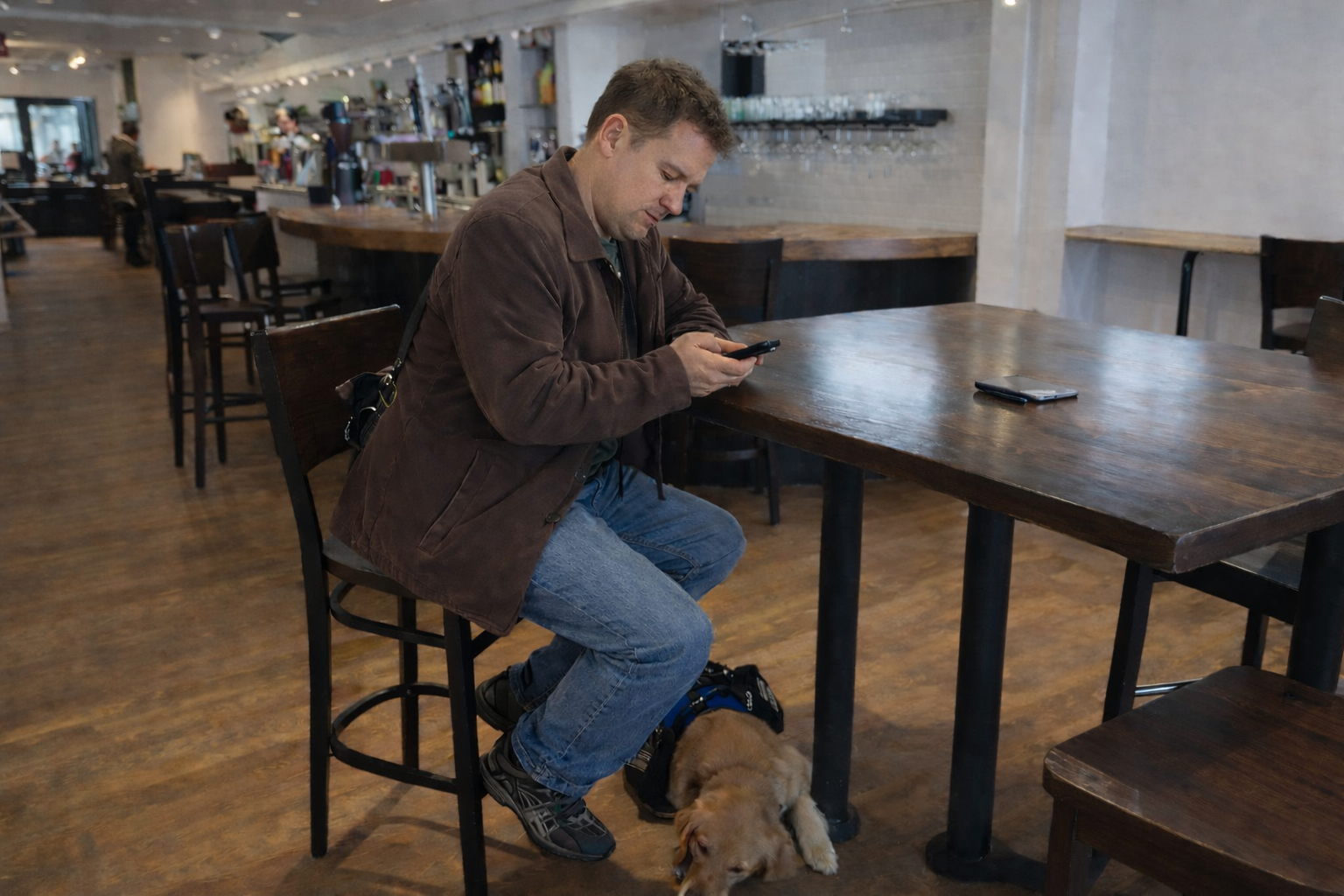
They Reduce Isolation Through Public Access, Not Just Companionship
A service dog can go into public places and that access changes what daily life looks like. A service dog can accompany a veteran even to unusual places like public transportation or medical settings such as waiting rooms and exam rooms
Public access with a service dog helps in two main ways:
- Less isolation. The veteran is not facing the outside world alone. The dog’s trained presence can make leaving the house feel safer and more manageable.
- More follow-through on care. Appointments are often hardest to keep when anxiety, sleep disruption, or pain is flaring. A service dog can make it more likely the veteran will attend routine medical and mental health visits, rather than avoiding them.
Many veterans report that having their service dog beside them is a key reason they are able to show up for the care that supports stability and long-term health.
Proof
For years, many people believed that service dogs could help veterans with PTSD, but the medical world wanted stronger evidence.
So Congress directed the U.S. Department of Veterans Affairs (VA) to study it. In a large, multi-year project, the VA compared veterans who received trained service dogs with a comparison group. The VA then tracked mental health outcomes over time.
When the results came in, the VA reported that veterans partnered with service dogs showed clear, measurable gains, including lower suicidal ideation and better PTSD-related outcomes.[3]
With that evidence in hand, Congress passed the PAWS Act, acknowledging that service dogs are an evidence-supported support for veterans with PTSD. That recognition mattered, because it helped the medical world take service dogs more seriously as part of suicide prevention and whole-person care.[4]
Sources
[1] Leighton, S. C., MacLean, E., & O’Haire, M. E. (2024). Service dogs for veterans and military members with PTSD: Associations with PTSD severity and psychosocial functioning. JAMA Network Open. https://doi.org/10.1001/jamanetworkopen.2024.14686
[2] Kitzinger RH Jr, Gardner JA, Moran M, et al. Habits and routines of adults in early recovery from substance use disorder: Clinical and research implications from a mixed methodology exploratory study. Subst Abuse: Res Treat. 2023;17:11782218231153843. doi:10.1177/11782218231153843.
[3] PAWS Act (U.S. Congress): H.R. 1022, 117th Congress (2021–2022), “Puppies Assisting Wounded Servicemembers (PAWS) Act.”
[4] Richerson, J. T., Wagner, T. H., Abrams, T., Skelton, K., Biswas, K., Illarmo, S., McSherry, F., Fallon, M., Frakt, A., Pizer, S., Magruder, K., Groer, S., Dorn, P., Huang, G., & Stock, E. (2023). Therapeutic and economic benefits of service dogs versus emotional support dogs for veterans with PTSD. Psychiatric Services, 74(8), 790–800. https://doi.org/10.1176/appi.ps.20220138
Learn more
➡️ How dogs are selected and trained
➡️ What qualifies a veteran to get a service dog?
➡️ Service dog laws: ADA, housing, and air travel
➡️ How does a veteran travel with a service dog?
Your gift supports the next service dog in training.